Particularly
when you’re around those who thrive on chaos, be willing to decline the
invitation to join in on the drama.
2.
Focus on your breath
Throughout
the day, stop to take a few deep breaths. Keep stress at bay with techniques
such as “square breathing.”
Breathe in for four counts, hold for four counts,
then out for four counts, and hold again for four counts. Repeat this cycle
four times.
3. Get organized and purge old items
A
cluttered space often creates a cluttered spirit. Take the time to get rid of
anything you haven’t used in a year and invest in organizational systems that
help you sustain a level of neatness.
4. Stop yourself from being judgmental
Whenever
you are tempted to have an opinion about someone else’s life, check your
intentions. Judging others creates and promotes negative energy.
5. Say ‘thank you’ early and often
Start
and end each day with an attitude of gratitude. Look for opportunities in your
daily routine and interactions to express appreciation.
6. Smile more
Even
if you have to “fake it until you make it,” there are many scientific benefits of smiling and laughing.
Also, pay
attention to your facial expression when you are doing neutral activities such
as driving and walking. Turn that frown upside down!
7. Don’t worry about the future
As
difficult as this sounds, there is a direct connection between staying in the
present and living a more peaceful life. You cannot control the future. As the
old proverb goes, “Worry is like a rocking chair. It gives you something to do,
but it won’t get you anywhere.” Practice gently bringing your thoughts back to
the present.
8. Eat real food
The
closer the food is to the state from which it came from the earth, the better
you will feel in eating it. Choose foods that grew from a plant over food that
was made in a plant.
9. Choose being happy over being right
Too
often, we sacrifice inner peace in order to make a point. It’s rarely worth it.
10. Keep technology out of the bedroom
Many
studies, such as one conducted by Brigham and Women’s Hospital, have connected blue light of
electronic devices before bed to adverse sleep and overall health. To make
matters worse, many people report that they cannot resist checking email and
social media when their cell phone is in reach of their bed, regardless of the
time.
11. Make use of filtering features on social media
You
may not want to “unfriend” someone completely, however you can choose whether you want to follow
their posts and/or the sources of information that they share.
12. Get comfortable with silence
When
you picture someone who is the ultimate state of peace, typically they aren’t
talking.
13. Listen to understand, not to respond
So
often in conversations, we use our ears to give us cues about when it is our
turn to say what we want to say. Practice active listening, ask questions,
process, then speak.
14. Put your troubles in a bubble
Whenever
you start to feel anxious, visualize the situation being wrapped in a bubble
and then picture that sphere floating away.
15. Speak more slowly
Often
a lack of peace manifests itself in fast or clipped speech. Take a breath, slow
down, and let your thoughtful consideration drive your words.
16. Don’t procrastinate
Nothing
adds stress to our lives like waiting until the last minute.
17. Buy a coloring book
Mandala
coloring books for adults are becoming more popular because of their connection
to creating inner peace.
18. Prioritize yourself
You
are the only person who you are guaranteed to live with 24 hours a day for the
rest of your life.
19. Forgive others
Holding
a grudge is hurting you exponentially more than anyone else. Let it go.
20. Check your expectations
Presumption
often leads to drama. Remember the old saying, “Expectations are premeditated
resentments.”
21. Engage in active play
Let
your inner child come out and have some fun. Jump, dance, play, and pretend!
22. Stop criticizing yourself
The
world is a hard enough place with more than enough critics. Your life is not
served well by being one of them.
23. Focus your energy and attention on what you want
Thoughts,
words, and actions all create energy. Energy attracts like energy. Put out
what you want to get back.
24. Assign yourself “complaint free” days.
Make
a conscious decision not to complain about anything for a whole day. It might
be harder than you think and the awareness will stick with you.
25. Surround yourself with people you truly enjoy being in the company
of
Personalities
tend to be contagious, and not everyone’s is worth catching. Be judicious in
your choices.
26. Manage your money
Financial
concerns rank top on the list of what causes people stress. Take the time each
month to do a budget, calculate what you actually spend and sanity check that
against the money you have coming in.
27. Stop trying to control everything
Not
only is your inner control freak sabotaging your sense of peace, it is also
likely getting in the way of external relationships as well.
28. Practice affirmations
Repeat
positive phrases that depict the life and qualities you want to attract. It may
not come naturally to you, but it works.
29. Get up before sunrise
Personally
witnessing the dawn brings a unique sense of awe and appreciation for life.
30. Be yourself
Nothing
creates more inner discord than trying to be something other than who we really
are. Authenticity breeds happiness.
Self confidence can get you far in this world. Employers, potential partners and friends all appreciate strong, self confident people. It's an admired trait. But even if you don't FEEL confident, there are ways to APPEAR confident, and when you succeed in doing that, you'll find that, very quickly, you actually feel as confident as you seem to be!
1: Practice exhibiting confidence through your body language
Body language is a kind of non verbal communication, where thoughts, intentions, or feelings are expressed by physical behaviors, such as facial expressions, body posture, gestures, eye movement, touch and the use of space.
There is much evidence pointing to body language as a path to developing real self confidence. A 'fake it till you make it' approach can actually generate real confidence. So stand up straight, don't slouch, don't look at the floor. Pull your shoulders back, push out your chest a bit and have some space between your feet when you stand.
Also, don't touch your face when talking to others, this is a clear sign of a lack of confidence, don't play with your hair or look anywhere but the person you are talking to. .
2:Smile
Smiling is powerful. It makes others realize you have it good, that you are relaxed and content.
Smile and let it show in your eyes. You'll see it not only makes a big difference in how people relate to you, but it also, eventually, makes you feel that much better.
3:Make eye contact and keep it
Don't be the first to look away. When your eyes meet another, hold the gaze, especially if you or they are talking. Don't stare, just move your eyes to theirs and hold, let them drop to the face and then back up. Don't break eye contact quickly, people who will immediately break eye contact give the impression that they either feel guilty for something, don't trust the person or are bored.
You can practice this with random people, and you may be surprised at their reaction when you get the nerve just to look them in the eyes. It will transmit confidence and interest.
4: Don't fidget
Compulsively moving your foot or nodding as someone else is talking transmits a lack of calm. To develop your self confidence, you'll need to be aware of your body and keep calm. If you feel yourself start to fidget, take a deep breath, disconnect for a moment and count to 3. Then release your breath and return to reality in control of your body.
5: Halt before you talk
When you are talking to another person, listen to them intently, don't cut them off and don't start talking immediately after they are done. Take 3 seconds to process the information, and then formulate a response that is quiet and shows that you really listened. Use specific details if possible. The time you take to think and process what the other person said would make you look more confident, wiser and kinder.
6:Let others speak
Continuing from our last point, try to get people to talk. Find out what questions they like being asked and encourage them to answer. People love being listened to, and once you do you'll discover there is always an advantage to knowing more about the person than they know about you. Also, the more open and direct you are in your questions, the more confident you'll seem. Just one word of advice: There is a thin line between being direct and being rude, find it and tread it carefully, you want to ask good questions but do it in a kind and offhand manner that'll put others at ease.
7: Don't cut people off
We return to this point because it is so common. Many of us just listen to the gist of what people are saying while waiting to give our own input. But being cut off is annoying, insulting and sometimes hurtful. Besides, you may miss out on important information. This takes a lot of patience, especially when people will just talk your ear off. But once you gain control of this need to give your own input right away, you'll discover it has powerful advantages. A man in control is a confident man, one who can listen to others' mistakes without having to correct them immediately.
On the other hand, if someone cuts you off, be assertive but calm, and ask politely that you be given the opportunity to finish. Don't look grouchy, they probably didn't mean to do it, just smile and be kind about it.
8: Dress well
It's amazing how much we get judged on visuals alone. You can take great advantage of that fact by being always well dressed.
Get an honest friend to tell you what looks good on you and what does not. Find a balance between comfort and a great look.
9: Exercise
Yes, even in an article about self confidence you won't escape this essential advice. Physical activity is a huge source of self confidence. Research has demonstrated that there is a direct link between sports and chemicals being released in the brain to cause euphoria.
Physical activity will also improve your looks, which will also add to your self confidence. And don't forget, just proving to ourselves what our bodies can do is a great boost to our confidence. Do any kind of physical activity for a better overall feeling and a great boost in self pride and respect.
10: Remember the good times
One of the things that we rely on for self confidence is reliving the best moments of our lives. Each time you remember that great day - a game you won, a trip you took, a person you loved - this will do wonders for your self-esteem, as well as providing a good excuse to call old friends
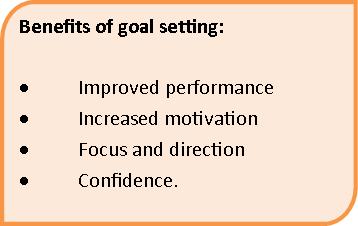
If we want to succeed in any activity undertaken by us, we need to set goals. Without goals we lack focus and direction. Goal setting not only allows us to take control of our life’s direction; it also provides us a benchmark for determining whether we are actually succeeding.
To accomplish our goals, we need to know how to set them. Goal setting is a process that starts with careful consideration of what want to achieve, and ends with a lot of hard work to actually do it. In between there are some very well defined steps that transcend the specifics of each goal. Knowing these steps will allow us to formulate goals that we can accomplish.The human brain is set up to help you achieve goals that you sincerely believe are achievable.
Here are our five golden rules of goal setting:
1. Set Specific and Clearly Define Goals
Make sure your goals are concrete, concise and attainable.You should clearly define yourbusinessgoals from the very start, which should be specific and well defined. The point is for you to articulate exactly what you want to achieve.
2. Set SMART Goals
We have heard of setting “SMART goals” already. But do we always apply the rule? Simple fact is that for goals to be powerful, they should be designed to be SMART. There are many variations of what SMART stands for, but the essence is this – goals should be:
Specific.
Measurable.
Attainable.
Relevant.
Time Bound.
Set Specific Goals Your goal must be clear and well defined. Vague or generalized goals are unhelpful because they don't provide sufficient direction. Remember, you need goals to show you the way. Make it as easy as you can to get where you want to go by defining precisely where you want to end up. Set Measurable Goals Include precise amounts, dates, and so on in your goals so you can measure your degree of success. If your goal is simply defined as "To reduce expenses" how will you know when you have been successful? In one month's time if you have a 1 percent reduction or in two years' time when you have a 10 percent reduction? Without a way to measure your success you miss out on the celebration that comes with knowing you have actually achieved something. Set Attainable Goals Make sure that it's possible to achieve the goals you set. If you set a goal that you have no hope of achieving, you will only demoralize yourself and erode your confidence.
However, resist the urge to set goals that are too easy. Accomplishing a goal that you didn't have to work hard for can be anticlimactic at best,and can also make you fear setting future goals that carry a risk of non-achievement. By setting realistic yet challenging goals, you hit the balance you need. These are the types of goals that require you to "raise the bar" and they bring the greatest personal satisfaction. Set Relevant Goals Goals should be relevant to the direction you want your life and career to take. By keeping goals aligned with this, you'll develop the focus you need to get ahead and do what you want. Set widely scattered and inconsistent goals, and you'll fritter your time – and your life – away. Set Time-Bound Goals You goals must have a deadline. Again, this means that you know when you can celebrate success. When you are working on a deadline, your sense of urgency increases and achievement will come that much quicker.
3. Set Goals In Writing
By clearly defining your idea, your imagination, heart and intellect can begin to work together to make it a reality.The physical act of writing down a goal makes it real and tangible. So, we should write our goals down.The act of writing our ideas down, or say, keying them into our laptop, will force us to think in concrete terms. It will also spark additional ideas. This is the birth of our action plan. And, goals are nothing more than what you “plan” to accomplish.
4. Make An Action Plan
The best, perhaps the only, way to turn an abstract goal into an attainable reality is to create an action plan. By writing out the individual steps, and then crossing each one off as we complete it,and with this we’ll realize that we are making progress towards your ultimate goal. However, we don’t need a complete plan in place to rise to the challenge and embrace its possibilities. Achieve greater success by continually updating our action plan and integrating the new information and ideas we uncover.
5. Stick With It!
Remember, goal setting is an ongoing activity not just a means to an end. Build in reminders to keep ourselves on track, and make regular time-slots available to review our goals. Our end destination may remain quite similar over the long term, but the action plan we set for ourselves along the way can change significantly. Make sure the relevance, value, and necessity remain high.
I am glad to post this inspiring and motivating real Life Story of a Nurse who became General Manager of the same Hospital where she worked as a Nurse: Santy Sajan was born and grew up in Calicut, Kerala and studied in a Malayalam medium school. She had set her sights on being a doctor and although she sat for the entrance exam, she couldn't make it largely due to a lack of finances. Santy is the eldest of four children and with her father having passed away, she had to support herself and contribute to the family pool. With medicine ruled out, nursing was her next best bet. Santy believed it was her passport to see the world — precisely as it turned out. "I secured a seat in a Pharma course, but instead I decided to pursue a BSc (Nursing) course from a women's college," Santy said. "After I graduated, I spent close to 12 years in the Gulf being a bedside nurse. I then returned to India to do my MSc (Nursing)." During her stint in the Middle East, Santy married Sajan Neeliyanickal, an acquaintance from school. They had kept in touch and acquaintance had grown to love. For six years while she was in the Gulf, Santy kept in touch with her sweetheart — long distance — until her husband moved there. After returning to India, Santy joined Columbia Asia as a nurse manager in 2004. But she was always 'troubled' by a higher calling. "I didn't want to live out life as a nurse," Santy said. "I always wanted to head a hospital someday, preferably Columbia Asia." She began putting her dream into action. After leaving Columbia Asia, Santy moved to the US to do a PhD in nursing. She also completed an MBA in Medicine from Johns Hopkins University. No part of the journey was easy though. Her husband, who is in the business of health and fitness clubs, was a major driving force, while her son Ryan, now 13, also had to make sacrifices. "It was our dream and we lived it out together," she said. "We achieved it as a family. I funded my studies by doing part-time jobs and taking education loans. When I was doing my MBA, classes used to go on till 9 pm. My son used to do his homework in my college cafeteria and we used to return home together after classes. The only long holiday I've taken is maternity leave." Today, in a perfect suit, Santy manages the four floors of the hospital, running up and down the stairs at least 10 times daily.
She has 220 employees and 80 doctors under her charge and takes care ofrecruitments, accounts and assessments. Her strong belief in her capabilities paid off. She wakes up at 4 am and hits the gym before doing her household chores. She is usually in the hospital until 8 pm. She is still very aware of her roots. "Nurses are the backbone of any hospital, but what is missing is dignity of labour. In the US, most hospitals are run by nurses, but in our country there is little regard for the profession. I am still a nurse at heart and will never forget that compassion and care that the profession imbibes in you. But I think nurses should explore the plethora of opportunities before them. No job is menial and every profession needs to be looked on with respect."
Malvika Iyer , the essence of courage and optimism.
The incidents in the life of Malvika Iyer is a real life story of a young girl with determination to come up in her life .Her inspirational and motivational life story is guiding beacon to thousands of handicapped persons like her.
A bilateral amputee from a freak bomb blast in 2002, Malvika Iyer is :
A Junior Research Fellow at Madras School of Social Work.
Global Shaper (An initiative of the World Economic Forum)
Speaker at TEDxYouth@Chennai 2013, MMA Women Managers' Convention 2014
Master of Ceremonies (MC) at India Inclusion Summit, 2013 at Ritz Carlton, Bangalore, GFK Run 2014
State topper in class 10th in 2004
Invited to meet with Dr. APJ Abdul Kalam in Rashtrapati Bhavan
Recipient of 'Outstanding Model Student' from Wisdom International Magazine
Recipient of 'Rolling Cup' for the 'Best M.Phil. Thesis' in 2012
Awarded certificates, cash prizes and medals for meritorious performance by Sri Sivakumar Educational & Charitable Trust, the DMK President- M. Karunanidhi, the Congress President Mrs. Sonia Gandhi, Rajya Sabha MP- Mrs. Renuka Chowdhury, the Chief Minister of Kerala- Mr. Oommen Chandy, Astrologer- SAP Varadhan, the Chairman and Director of Art Heritage Gallery- Mr. E. Alkazi, Rotary Club, Punjab Association
Worked with differently abled children at the Centre for Child and Adolescent Well Being, Delhi
Undertook research projects in PEHEL, Schizophrenia Research Foundation (SCRAF)
Model for accessible clothing in India (An initiative of Ability Foundation- NIFT)
Alumnus of St. Stephen's College, Delhi and Delhi School of Social Work
When Malvika was 13 years old, a freak accident caused her to lose both her hands and severely damaged her legs, raising serious doubts about whether she would ever walk again.
But young Malvika braved the odds and emerged victorious. Today she is a dedicated social worker, a motivational speaker and model for accessible clothing in India.
Malvika is also a Global Shaper from the Chennai Hub, which is a part of the Global Shapers Community, an initiative of the World Economic Forum.
She gives a first person account of her ordeal and how she overcame it to S Saraswathi.
Let us hear Malvika Iyer in her own words:
I was born in Kumbakonam. My father was transferred to Rajasthan when I was still very young. I spent nearly 13 years of my early life in Bikaner, Rajasthan.
I had a very healthy and a happy childhood. I was a tomboy; I enjoyed outdoor sports and learnt swimming and skating. I also learnt Kathak for about seven years.
It was a fun-filled life till the day I met with the accident: May 26, 2002. I was 13 years old.
The accident:
Some months before the accident, an ammunition depot had caught fire in the city and hand shells, grenades and other bits and pieces were scattered all over the city. One such piece landed in our neighbourhood.
We were told that it was a diffused shell. I was trying to stick something on my jeans pocket, and I wanted something heavy to hammer it with. I just took this shell and hit it.
With the first hit, the shell exploded in my hand.
There was almost nothing left of my hands. Both my legs had severe injuries, nerve damage and multiple fractures.
It took nearly two years and several surgeries for me to walk again.
Bedridden for two years:
For the first three days after the explosion, I was totally conscious, aware of each and every thing happening around me, but my body was numb.
Within moments of the explosion I heard my mom screaming, "Meri bachhi ke haath chale gaye!"
I was taken to the hospital immediately. There was so much damage to my limbs that my body went into a state of shock. I could not feel anything as the four main nerves were instantly cut. There was 80 per cent blood loss.
When I reached the hospital there was zero BP, the doctors were not sure if I would survive.
Even in that state I remember apologising to my mom, telling her that I am sorry I put her through this. Then I said I wanted to meet this friend of mine. It was so strange. I gave the contact number of my friend and told my parents to call her. I was terrified; would this really be the last time I was going to see these people?
The doctors were not sure that they would be able to save my leg, especially the left one. It was dangling, just hanging from a small bit of skin. They wanted to amputate it, but my parents did not want to risk any more damage. They took me in an ambulance to Jaipur.
The splinters were stuck all over my legs and had penetrated deep within. The pain began to sink in and it was terrible. I can remember those days and nights filled with pain.
But the doctors were good and managed to save my leg. Though completely disfigured, with no sensation in my left leg and a foot drop (difficulty in lifting the front part of the foot) in the right, I am lucky I still have them.
My hands, though, were completely cut off. There was no need to amputate them because they had been blown off; they couldn't even find any trace of them at the accident site.
Later a skin grafting operation was done and with that I am left with just two stumps. Fortunately, the stumps, especially the right one, were quite long, so I was able to lift them like how a squirrel does.
I was treated at a Bone and Joint clinic in Anna Nagar in Chennai. After months of intense therapy, I was finally able to walk.
My accident happened in May 2002. I took my first few painful steps in November 2003.I still had a long way to go.
Getting on with life:
We started enquiring about artificial hands. There was not much awareness about this, so my mom and I used to Google. We found a German prosthetics company called Ottobock that had a branch in Chennai.
That is how I got a pair of bio-electric hands.
I started practising to write; initially my handwriting was very big, and then slowly, with practise, I improved.
This was in December 2003. In four months my friends would be appearing for their 10th board exams. I felt totally left out.
I was in touch with a very close friend in Bikaner. She used to tell me how they were preparing. I decided that I would give it a shot. My mom found this coaching centre right behind our street.
I had just three months to prepare. All my childhood, I have been into sports and dancing and skating, and now I could do nothing but sit and walk a bit. As I had no other choice, I think all my concentration went into academics.
I prepared and prepared and when the results came, my life was completely changed.
I got a State rank among the private candidates, and I was one among the State toppers, as well. I scored centum in both Math and Science and 97 in Hindi, also a State first.
I felt like a celebrity. The next day, all the leading newspapers covered me.
They wrote about how I overcame my disability to achieve this distinction. It was all very encouraging.
I was invited to Rashtrapati Bhavan to meet Dr APJ Abdul Kalam (then President of India).
Malvika Iyer with former Indian President Dr APJ Abdul Kalam
I got to meet a lot of other celebrities. I was given an award for outstanding model student by Wisdom magazine.
After 12th, I joined St Stephen's College, Delhi, where I graduated in Economics (Honours).
I then did my Master's in Social Work from the Delhi School of Social Work.
During my field training, I had the opportunity to work with differently-abled children. I realised that this is something I have to be a part of. I could empathise with them and understand them better. Since I was always given a lot of encouragement, I wanted to give something back.
A new beginning
Last year, I was invited for a TEDx Talk(In the spirit of ideas worth spreading, TEDx is a program of local, self-organized events that bring people together to share a TED-like experience. At a TEDx event, TEDTalks video and live speakers combine to spark deep discussion and connection in a small group. ) and that talk completely changed the course of my life.
Until then I was just doing my work and trying to be a part of society. But that wasn't helping me much and I would still feel bad that everybody else is normal and I am not.
But when I started talking about myself, I realised that I was actually much better off than a lot of people, who would complain even without any problem in their life.
I was seen as a motivational speaker. Now I get invited to talk at colleges and schools or to corporates in Chennai and other cities.
Last year, I was invited to host the India Inclusion Summit in Bangalore. I was the emcee and had the opportunity to meet a lot of differently-abled people.
Malvika speaking at India Inclusion Summit
There were people who had actually achieved something or who were in the process of recovering and coming out of it. It was a great honour to be able to host such a programme.
This helped me realise that I have to accept my disability. It is not like I am ever going to get my hands back.
The people around me made this possible -- my friends, my family, and my mom especially. She was my support throughout. She was like my shadow. She made sure that nobody hurt me in any way. It is her positive spirit that has made me who I am today.
She has given me a lot of freedom; she never treated me differently at all. There was never any show of pity.
Presently, I am Junior Research Fellow doing my PhD in Social Work at the Madras School of Social Work. I am studying the experience of inclusion; how differently-abled people feel in society and what is society's attitude towards them.
Initially, I used to feel bad when people stared at me. It made me very uncomfortable, but now it does not matter. I know who I am. I have become more strong-hearted, what they feel or how they see me does not affect me any more.
Apart from this, I have been passionately working on everything outside. Recently I did a ramp walk at NIFT (National Institute of Fashion Technology), Chennai.
I am a model for accessible clothing(Clothing designed for persons with disabilities, to allow more independence in dressing. Its use is intended for those who have difficulty dressing, as well as for those with special clothing needs.); it is an initiative of Ability Foundation and NIFT.
Malvika Iyer on the ramp at NIFT
The students designed two gowns for me, taking into considering my prosthetic hand. I was the showstopper for that evening and it was an amazing experience. Ever since then I have been writing about accessible clothing.
When I was in the hospital bed 12 years ago, I thought that I could never come out of this. Now I can see that there is so much more to do. I think life is really, really good.
I was invited to host a Run in Bangalore recently.
I went all by myself. I handled everything, from the airport, all the travelling, the stay in the hotel, etc. Today I can do 90 per cent of my work on my own, without any assistance.
When I think about how my life has turned out to be, I think it is fine, whatever happened.
I would not have wanted to live a mediocre life. I have always been scared of mediocrity and I am not sure how my life would have turned out if it were not for this accident.
I feel I am blessed because I know that something very horrible happened and even now it is not like I am 100 per cent all right. I can't just run around and do everything on my own. My legs still hurt when I walk.
But a lot of good has come my way.
I am confident I can do something meaningful with this life. I don't have any regrets.
Dancing was my first love. I used to be sad that I could not dance like before. But now I have started dancing again. I cannot dance as gracefully as before, but I still dance.
At the Bangalore Run, I danced on the stage. I think life is all about making the best with what you have.
I got engaged in February this year to a wonderful man, a design engineer, and there is a lot to look forward to in life rather than just sitting around thinking of what could have been.
"I learnt to embrace every inch, every scar and every emotion."


 Breathe in for four counts, hold for four counts,
then out for four counts, and hold again for four counts. Repeat this cycle
four times.
Breathe in for four counts, hold for four counts,
then out for four counts, and hold again for four counts. Repeat this cycle
four times. Also, pay
attention to your facial expression when you are doing neutral activities such
as driving and walking. Turn that frown upside down!
Also, pay
attention to your facial expression when you are doing neutral activities such
as driving and walking. Turn that frown upside down!