Google ad

Friday, March 4, 2016

Fascinating Facts about the Dead Sea


    The Dead Sea – bordering Israel, the West Bank and Jordan – is a salt lake whose banks are more than 400m below sea level, the lowest point on dry land. Its famously hyper-saline water makes floating easy, and its mineral-rich black mud is used for therapeutic and cosmetic treatments at area resorts. The surrounding desert offers many oases and historic sites.
    The Dead Sea has attracted visitors from around the Mediterranean basin for thousands of years. In the Bible, it is a place of refuge for King David. It was one of the world's first health resorts (for Herod the Great), and it has been the supplier of a wide variety of products, from asphalt for Egyptian mummification to potash for fertilizers. 

    People also use the salt and the minerals from the Dead Sea to create cosmetics and herbal sachets.
    Source:Wikipedia
    Now let us see some of the fascinating facts about Dead Sea

    1. The surface and shores of the Dead Sea are 423 metres (1,388 ft) below sea level, making it Earth’s lowest elevation on land.

    2. The Dead Sea is 377 m (1,237 ft) deep, making it the deepest hypersaline lake in the world. A hypersaline lake is a landlocked body of water that contains significant concentrations of sodium chloride or other mineral salts, with saline levels surpassing that of ocean water.

    3. With 33.7% salinity, the Dead Sea is one of the world’s saltiest bodies of water. Although Lake Assal (Djibouti), Garabogazköl and some hyper-saline lakes of the McMurdo Dry Valleys in Antarctica (such as Don Juan Pond) have reported higher salinity.

    4. The Dead Sea’s unusually high salt concentration means that people can easily float in the Dead Sea due to natural buoyancy. In this respect the Dead Sea is similar to the Great Salt Lake in Utah in the United States.
     
    5. The Dead Sea is roughly 8.6 times saltier than the ocean. This salinity makes for a harsh environment in which animals cannot flourish (hence its name). The high salinity prevents macroscopic aquatic organisms such as fish and aquatic plants from living in it, though minuscule quantities of bacteria and microbial fungi are present.

    6. The Dead Sea is 67 kilometres (42 MI) long and 18 kilometres (11 MI) wide at its widest point. It lies in the Jordan Rift Valley and its main tributary is the Jordan River.

    7. The Dead Sea area has become a major center for health research and treatment for several reasons. The mineral content of the water, the very low content of pollen and other allergens in the atmosphere, the reduced ultraviolet component of solar radiation, and the higher atmospheric pressure at this great depth each have specific health effects.

    8. Biblically, the Dead Sea was a place of refuge for King David. It was one of the world’s first health resorts (for Herod the Great), and it has been the supplier of a wide variety of products, from balms for Egyptian mummification to potash for fertilizers.
    9. An unusual feature of the Dead Sea is its discharge of asphalt. From deep seeps, the Dead Sea constantly spits up small pebbles and blocks of the black substance. Asphalt coated figurines and bitumen coated Neolithic skulls from archaeological sites have been found. Egyptian mummification processes used asphalt imported from the Dead Sea region.

    10. The world’s lowest road, Highway 90, runs along the Israeli and West Bank shores of the Dead Sea at 393 m (1,289 ft) below sea level.

Thursday, March 3, 2016

Li-Fi could soon replace Wi-Fi with speeds up to 100 times faster


LED lamps in our houses could soon provide you with blazing-fast Internet speeds, leaving the  old Wi-Fi connection in the dust. It's all thanks to a new technology called Li-Fi, short for "light fidelity," which transmits information wireless via visible light.
What is Li-Fi?
Light Fidelity (Li-Fi ) is a bidirectional, high speed and fully networked wireless communication technology similar to Wi-Fi. The term was coined by Harald Haas ] and is a form of visible light communication and a subset of optical wireless communications (OWC) and could be a complement to RF communication (Wi-Fi or Cellular network), or even a replacement in contexts of data broadcasting. It is so far measured to be about 100 times faster than some Wi-Fi implementations, reaching speeds of 224 gigabits per second.
It is wireless and uses visible light communication or infra-red and near ultraviolet (instead of radio frequency waves) spectrum, part of optical wireless communications technology, which carries much more information, and has been proposed as a solution to the RF-bandwidth limitations.
How fast will be Li-Fi?
The thing that makes Li-Fi so revolutionary is its incredible speed, up to 100 times faster than Wi-Fi. With that speed we can download contents of 23 DVDs in just one second using a Li-Fi connection. Laboratory tests have shown speeds of over 200 Gbps. It could solve the bottleneck problem that currently exists with our Wi-Fi networks, which will only be compounded as an estimated 50 million different objects and devices are expected to be connected to the Internet by 2020.
What is the disadvantage of Li-Fi?
For all of its advantages, Li-Fi does has one drawback. Because it transmits data with visible light, our device has to be in a lit room for it to work. 

Forget about using it in the dark, or out in the bright sunlight for that matter. Sunlight interferes with the artificial light that is transmitting the information. Li-Fi also can't pass through walls, for the same reason that the light from a closed room doesn't illuminate any surrounding rooms.
Will Li-Fi replace WI-Fi completely?
So Wi-Fi will be continued to be in use even after Li-Fi gets widely implemented. The idea will be to use them in tandem, to get the benefits of each .

Tuesday, February 23, 2016

Different Types of IDLIS


Idli is a traditional breakfast in South Indian households. Idli is a savoury cake that is popular throughout India and neighbouring countries like Sri Lanka. The cakes are usually four to five inches in diameter and are made by steaming a batter consisting of fermented black lentils (de-husked) and rice. The fermentation process breaks down the starches so that they are more readily metabolized by the body.

It’s nutritious and it’s steamed – making it absolutely safe even in the dingiest highway restaurant.


It also comes with markedly different flavours depending on which part of Tamil Nadu, Karnataka or Kerala you’re at.


Let us look at the different types of Idli 

1. The ‘grainy’ Udupi idli: 


In Bengaluru and Chennai’s traditional Udupi restaurants like serve this dish.

This idli uses the same 3:1 (rice:urad dal) mix but the batter is coarse lending a grainy texture to these idlis that are not overly fluffy

2. Chettinad idli-Khushboo Idly. 

It's very soft and fluffy because the batter is ground to an extra fine consistency while some chefs also use a 4:1 (rice : urad dal) mix. 


Murugan Idli Kadai (originally from Madurai) have made this version of idli extremely popular.

3. Kancheepuram Idli: 

We can trace its origins in the Vardarajaswamy temple in this legendary temple town where it is still the ‘temple prasad’. This coarse idli uses a 2:1 (rice:urad dal mix) and used to be traditionally cooked in large vessels (and not idli moulds) and then sliced. 

The batter is stored overnight and then blended with ghee, cashew, Bengal gram, jeera, curry leaves, ginger powder and peppercorns before being steamed. This flavour some idli doesn’t really need any accompaniment.

4. Rava Idli: 

Most people will argue that the Rava Idli doesn’t really qualify as an idli except for its shape. The batter (Rava mixed with curd) doesn’t require fermentation – in fact it needs to be cooked immediately, and it tastes very different from the conventional idli.
Bangloreans used to queue up for MTR Rava Idlis for decades. Now you can try their instant Rava Idli mix.

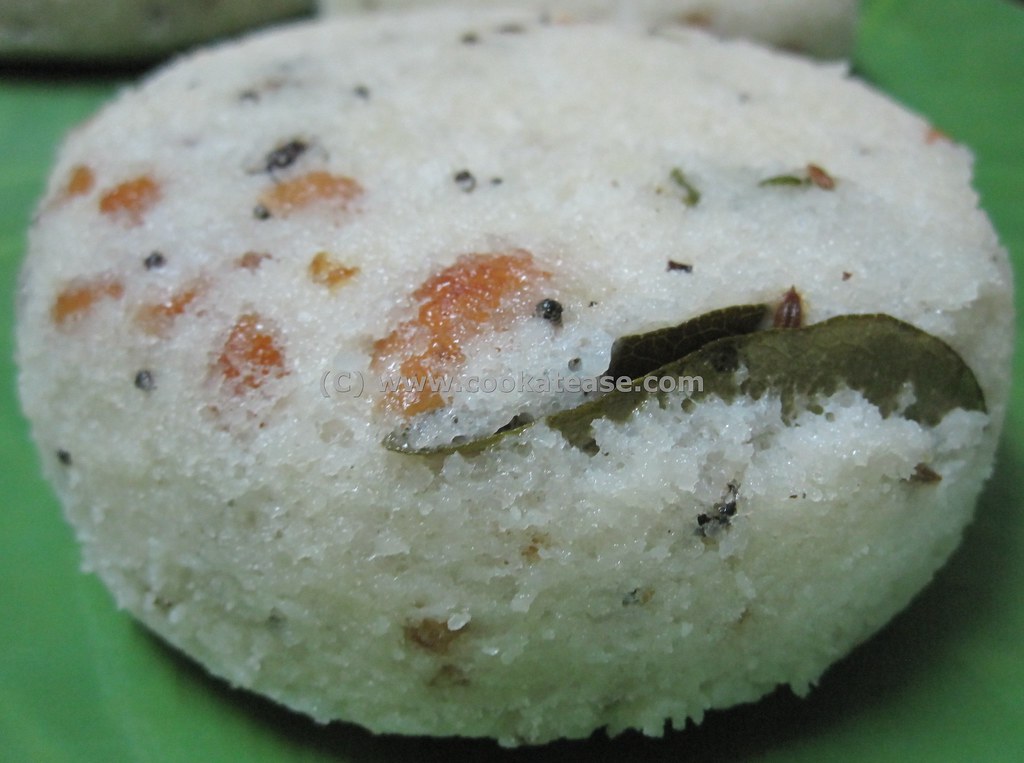
5.Oats Idli


A fine example of how low calorie food can taste exquisite, oats idli made from powdered oats and carrots are ideal for those trying to cut the carbohydrates. A fine example of how low calorie food can taste exquisite, oats idli made from powdered oats and carrots are ideal for those trying to cut the carbohydrates

The Kancheepuram Idli served as temple prasad

6. Kadubbu or Moode:

These cylindrical idlis are quite common place in and around Udupi. From Kadubbu to Moode (or Mude) to Gunda the locals use quite a few terms to describe this uniquely shaped idli. 
It’s the same batter cooked in a different mould. The conical moulds are crafted almost artistically with jackfruit leaves. The leaves add a subtle flavour to the idli.
7. Ramasseri Idli:

These flat, super soft idlis are almost the size of a small dosa and are prepared in specially designed mud pots that are mounted one on top of the other (typically three to five in a row)

Ramasseri Idli at Karavalli

8. Thatte Idli:

If you’re ever driving from Bengaluru to Mysuru, do make a pit stop at Bidadi that has acquired quite a reputation for its unique version of the idli – Thatte Idli. As the name suggests these Idlis are steamed in plates (in regular steamers) and are usually served tarkari(vegetable) saagu.


Thatte Idli at Bidadi

9. Bite-Sized ‘Mini’ Idlis: 

Investing in an extra idli mould to make coin-sized idlis gives you quite a few snack options. These small cocktail idlis can be tossed with idli powder and curry leaves or deep fried and tossed in a spice mix. You could also dunk them in a bowl of sambhar.


10. Stuffed Idli 
A lovely version from Udupi, stuffed idlis make a light yet filling fit. Stuffed with dal, nuts and vegetables.


idli-recipe-photo-2.jpg